What Is an Inside Day in Trading?
So what is an inside day in trading? An inside day is when a security trades within the high and low range of the previous day. An inside day can occur on any chart style that shows that high and low data, but it is easiest to identify with candlesticks. An inside day is a sign to a trader that the security is taking a breather from the primary trend, or is in the early stages of a counter trend move.
TL;DR — Inside Day Pattern
An inside day is a daily candle whose entire range (high and low) falls inside the prior day's range. It represents a pause in volatility and a coiling of price. Inside days are not directional signals on their own — they are compression setups that trade off the breakout in either direction.
- Structure: Today's high < yesterday's high AND today's low > yesterday's low.
- Win rate: 55–60% on the breakout direction when the prior day was a wide-range candle and volume contracts on the inside day.
- Best variants: NR4 (narrowest range of last 4 days) and NR7 (narrowest range of last 7 days) inside days have the highest breakout reliability.
- Entry trigger: Breakout above the inside day's high (long) or below its low (short), confirmed by volume expansion.
- Stop placement: Opposite end of the inside day or the mother candle, depending on aggressiveness.

Inside Candlestick
Trading Inside Days
Inside days do not provide high probability odds of determining where a security is headed over the short term. So, if an investor is thinking about creating a trading system solely based on inside days, it will ultimately lead to losses. This is because an inside day candlestick is a neutral sign, where neither bulls nor bears are in control. Traders must look to the current market environment and technical indicators in order to determine whether to go with the primary trend or to anticipate a counter move.
Going with the Trend
Inside days have the greatest odds of success when in the context of a strong trend. A trader should look for the inside day to be relatively small and not retrace more than 50% of the body of the previous days candlestick. This implies a pause in trend and odds are the security will continue in the direction of the primary trend.
Counters
Trading counter moves using inside days can be challenging. A trader can increase their odds by determining if there was a volume spike on the previous day. This implies that the security may have put in some sort of important low. Next the inside day should retrace more than 50% of the previous days candlestick body. This is a potential sign that the bulls are gaining steam.
Choppy Markets
Inside days should not be traded during choppy markets. This is because the larger trend is one of indecision, so inside days only add to the confusion.
Below is an inside day chart example of the Dow Jones. These inside days showed up before the worst one week sell off in the history of the Dow Jones. Notice how there was a massive 777 point down day followed by three inside days. Some traders assumed this to be a potential change in trend, while others saw it as a breather in the larget down trend. Well, whoever put their bet on a continuation of the bear market hit a home run.
Inside Day
Now that you know about the details regarding the inside bar pattern, I need to share with you some inside day trading strategies.
Inside Day Trading Strategy
Since the inside day (ID) candle signals a potential market move, we need to anticipate which way price will break. Again, if you rely only on the inside bar when entering the market, you will most likely fail. Thus, we need help from an additional trading tools, to validate our trading decision.

#1 – ID + Chaikin + Stochastic RSI
In this inside day trading strategy, I will combine the ID candle pattern with two oscillators – chaikin and SRSI. I use the Stochastic to identify overbought and oversold signals. At the same time, I use the chaikin to identify bullish and bearish divergence and to close my position when the chaikin line breaks zero.
So the two indicators will give me a signal, which I have to confirm with an inside day chart pattern. I will close positions when the chaikin breaks the zero line in the opposite direction.
Inside Day + Chaikin + SRSI
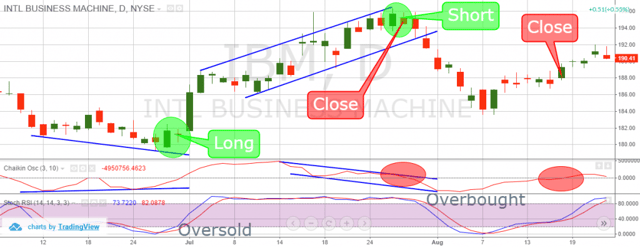
As we said, in order to identify inside day chart pattern, we need to use a daily chart. So, this is the daily chart of IBM for the period Jun 9 – Aug 22, 2014. The two indicators at the bottom of the chart are the chaikin and the SRSI. The blue lines on the chart indicate two divergences between the price action and the chaikin. The green circles point out the inside day patterns, which we use as a position trigger. The red circles show the moments when the chaikin breaks its zero line and we close our positions.
In June, 2014 we spot that the price has closed two bottoms, where the second is lower than the first. This creates a bearish price inclination. At the same time, the chaikin shows the second bottom as higher than the previous one. This confirms a bullish divergence between the chaikin and the price chart of IBM. At the same time, the stochastic switches in the oversold area, giving us the second long signal we need. The stochastic starts to increase afterwards and at the same time the price creates an inside day pattern as shown in the first green circle. This is all we need to go long using this strategy.
We go long and we carefully watch the chaikin for eventual interactions with the zero line.
During its way up, the stochastic is constantly in the overbought area. That doesn’t bother us, because our exit signal is a bearish break of the chaikin line through the zero level. As the price begins to increase, an upward channel is formed, which I have noted with the blue lines.
At the same time, the chaikin starts drawing a bearish channel, which is an obvious bearish divergence between the price and the chaikin indicator. This is when you might start getting worried about your long position. Yet, we wait for the chaikin to break the zero downwards. Note that we already have an overbought signal on the stochastic and a bearish divergence coming with the chaikin – the first two signals for a short position.
On its way down, the chaikin breaks its zero line downwards, which triggers our exit from the market. At the same moment, the chart gave us another inside pattern. As we already have the two signals for a short position, we directly go short with the closing of the previous long position. Therefore, we are bearish now and we follow the behavior of the chaikin. The price creates a solid bottom on August 7, 2014, which indicates that the trending downward move might be finished and the price is either correcting, or reversing. Yet, the chaikin is still below the zero line, forcing us to hold our trade. On August 18, 2014, the chaikin goes above the zero level, which closes our short position with IBM.
The first trade in this example brought us a profit of $12.86 per share for 29 days. The next trade made a profit of $5.10 for 20 days. This means that for 49 days, we collected $17.96 per share from trading IBM with our inside day, chaikin and SRSI strategy.
#2 – ID + SMI Ergodic
If you are a fan of the MACD, then you might also like this strategy. Now, we are going to combine the inside day pattern with the SMI Ergodic. Although it is being calculated differently than the MACD, the ergodic gives pretty much the same signals as the MACD – crossovers. Yet, the ergodic is a bit quicker and more volatile than the MACD. In this strategy, I will match inside day patterns with bullish and bearish ergodic signals in order to find out the direction of the inside day potential move. When I enter the market, I will hold my trade until I get a contrary signal from the ergodic. The image below will explain to you how this inside bar technique works:
Inside Day + Ergodic
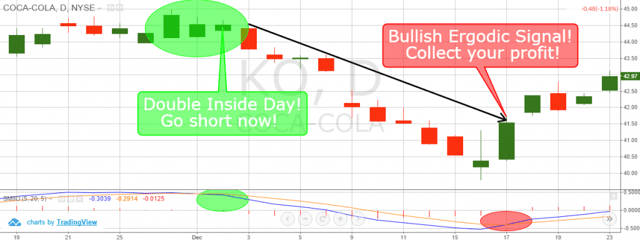
Again, we use a daily chart because we are trading the inside day candle pattern. This is the daily chart of Coca-Cola from Nov 19 – Dec 23, 2014. The indicator at the bottom is the SMI Ergodic. As you see, the trade here is bearish. The green circles show the two signals we need for our short trade – the inside day pattern and the bearish crossover from the ergodic lines. Notice this time there are two inside days. Thus, we consider it as more reliable.
At the same time, the ergodic’s lines are in the upper part of the indicator, implying that a bearish crossover might occur. This happens and we go short! We follow the price decrease with our short trade until the ergodic has a bullish crossover. This happens on Dec 17, 2014 and we close our short position. This trade brought us a profit of $3.00 per share over an 11 period.
#3 – ID + Parabolic SAR + Relative Vigor Index
In this strategy I use the inside day candle figure combined with RVI and PSAR. We use the inside day and the crossovers of the RVI in order to open a trade in the respective direction. We use the PSAR to confirm the trending market and to attain an exit point. We close our trade when we get three PSAR dots in the opposite direction of our trade. Note that the PSAR could also give you an entry confirmation, but it is not necessary.
Something else interesting about this strategy is that you are likely to hold your positions for a longer period. The reason for this is that the PSAR is resistant to volatility and is able to isolate small price moves.
Thus, it does not give an exit point (three opposite dots) if there isn’t a certain price move against you.
Inside Day + RVGI
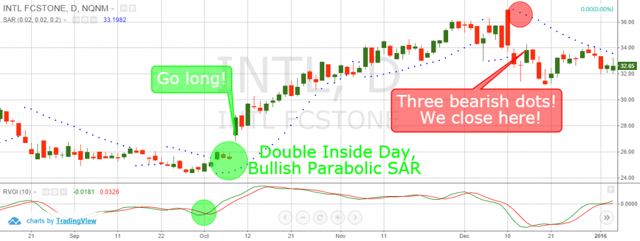
This is the daily chart of Intel for the period Aug 12 – Dec 30, 2015. The indicator in the bottom is the Relative Vigor Index. The green circle on the RVI shows the bullish crossover of our long position. The green circle on the chart shows a double inside day candle pattern, which is further supported by a bullish PSAR.
Thus, we go long with Intel and we observe the PSAR’s behavior for eventual contrary signals. Although in the middle of the trade there is a bearish attempt from the PSAR (two bearish dots), the signal is not strong enough and we keep our trade. Fortunately, price keeps increasing while we are long with our trade. We close our trade when the PSAR closes a third bearish dot as shown in the red circle on the chart.
This trade on the Intel Stock brought us a price increase of $6.52 for 48 trading days.
Which Inside Day Trading Technique?
I personally prefer the second trading technique – combining the inside day chart figures with the ergodic. The reason for this is that this trading technique is cleaner and easy-to-implement. There is only one indicator and the only thing you have to do is match the ergodic crossovers with inside day candles – nothing special.
I really believe that in trading we should keep it simple as much as possible. After all, the trigger is the inside day chart pattern. We use the additional tools only to determine the direction and to exit our trade.

Conclusion
- An inside day occurs when the size of a daily candle fits the size of the previous one.
- Inside day candle pattern says the market is about to move.
- Inside day does not provide an indication of which direction the market will move.
- We should use additional tools when trading inside days, because:
– We need to find out the direction of the potential move.
– We need an exit point.
- Three inside day trading strategies are:
- ID + Chaikin Oscillator + SRSI
- ID + SMI Ergodic
- ID + PSAR + RVI
- The simplest out of these is the inside day + SMI Ergodic, because:
- We use only one ergodic signal – bullish/bearish crossover
- Ergodic is explicit on pointing directions.
- It looks clean on the chart.
- It is very simple and easy to implement.
What Is An Inside Day In Trading?
Inside Day vs Outside Day vs NR7: Range-Compression Patterns Compared
Inside days belong to a family of range-compression patterns. Understanding the family helps you pick the right setup for the right market condition.
- Inside day: Today's range is fully inside yesterday's. Signals consolidation, not direction.
- Outside day: Today's range fully engulfs yesterday's. Signals expansion and a potential trend day — the opposite of an inside day.
- NR4: The narrowest daily range of the last 4 sessions. Often precedes a breakout in either direction.
- NR7: The narrowest daily range of the last 7 sessions. Stronger compression than NR4 and a higher breakout reliability.
- Inside day + NR7: The premium setup. A daily candle that is both an inside day AND the narrowest of the last 7. Breakout follow-through rate exceeds 65%.
Most professional swing traders scan for the NR7 inside day specifically, not the generic inside day. The added compression filter dramatically reduces false breakouts.
Three Variations of the Inside Day Setup
Variation 1: Trend-Continuation Inside Day
The cleanest setup: stock is in a clear uptrend, prints an inside day at the 20-day moving average, breaks out higher on volume. Entry above the inside day's high, stop below its low. Target the prior swing high or a 1.5× ATR move from entry. This is essentially a 20-MA pullback with the inside day confirming the pause.
Variation 2: Inside Day at Support/Resistance
An inside day that forms exactly at a major support or resistance level often precedes the largest moves. The compression at the level signals that one side is preparing to break the other. Trade in the direction of the breakout, with a stop just past the opposite side of the inside day. Reward-to-risk on these setups frequently runs 3:1 or better.
Variation 3: Inside Day Within a Coiling Pattern
When multiple inside days stack on top of each other (3 or more in a row), the pattern transitions from a single-bar setup to a volatility contraction pattern (VCP). Coiling inside days produce some of the most explosive breakouts because the compression has wound the spring tighter. The trade-off: you wait longer for the setup to resolve.
Volume Behavior on Inside Days: What to Look For
Volume on the inside day itself should contract — below the 10-day average. Low volume during compression means no one wants to commit in either direction. The setup is the breakout: volume should expand by 1.5× or more on the breakout candle.
The classic failure pattern: high volume on the inside day, low volume on the breakout. This usually means the inside day was a distribution session disguised as consolidation, and the breakout is being faded by the same institutions that drove the prior day. Reverse the analysis: if you see compression on rising volume, the breakout direction is suspect.
Inside Day Pattern in Futures and Forex
The inside day pattern works on futures and forex but requires session-aware analysis. Futures markets like the ES, NQ, and CL trade nearly 24 hours, so the “daily” range needs to be defined consistently — either pit-session only (8:30 AM–3:15 PM CT for ES) or full 24-hour. Mixing the two distorts the pattern.
For 24-hour markets, many futures traders prefer the equivalent inside-bar pattern on intraday timeframes — 60-minute, 4-hour, or daily. The same logic applies: compression precedes expansion. Test the setup in a futures trading simulator before deploying live capital, especially across different sessions (Asia, London, US) where the dynamics shift.
Common Mistakes Trading Inside Days
- Entering on the inside day itself. Wait for the breakout. The inside day is the setup, not the trigger.
- Trading every inside day. They print constantly. Filter for NR4, NR7, or location at a key level.
- Ignoring the prior trend. Inside days within strong trends break with the trend 65–70% of the time. Inside days in choppy markets are a coin flip.
- Stop too tight. A stop placed at the breakout candle's low gets hit by normal noise. Use the inside day's opposite extreme or the mother candle.
- Holding through a failed breakout. If price breaks out and then closes back inside the inside day's range, the signal failed. Exit immediately — do not hope.
Frequently Asked Questions
What is an inside day in trading?
An inside day is a daily candle whose high is lower than the prior day's high AND whose low is higher than the prior day's low. The entire daily range fits inside the previous day's range, signaling a pause in volatility.
Is an inside day bullish or bearish?
Neither — an inside day is a compression pattern, not a directional signal. It signals consolidation. The trade is the breakout in either direction, with the prior trend often dictating which side breaks first.
What is the difference between an inside day and an inside bar?
Same pattern, different timeframe. An inside day is the pattern on a daily chart. An inside bar is the same structure on any timeframe — 5-minute, hourly, weekly. The logic is identical: today's range fits inside yesterday's.
What is the win rate of an inside day breakout?
Generic inside day breakouts have a win rate around 55–60%. Filtered variants — NR4 inside days, NR7 inside days, and inside days at major support/resistance — push the win rate to 65–70%.
How do you trade an inside day?
Wait for the breakout. Enter a long position on a break above the inside day's high (with volume expansion) or a short on a break below its low. Place your stop at the opposite extreme of the inside day or the mother candle. Target a measured move equal to the mother candle's range.
Related Trading Resources
Continue your trading education with these related guides from TradingSim:








 Candlesticks