Dividends per share – What are they and how they work?
Sep 21, 2018
Written by: Al Hill
✓ Reviewed by Kunal Vakil, Co-Founder of TradingSim · Updated Mar 31, 2026
Dividends per share, that term you have come across so many times. To understand dividends per share, you first need to understand what dividends are.
Dividends are technically a sum of money that is paid by a company to its shareholders. For some investors, this might sound interesting. What could be better than for investors to also get paid for holding stocks in a company?
It might sound too good to be true, but yes, companies do pay dividends. And there is an entirely different stream of investing that focuses purely on dividends.
Dividends are simply profit sharing mechanisms which allow a company to distribute profits to its shareholders.
Dividends are paid regularly!
It can be either paid annually or quarterly. A company usually announces how much of dividend it will pay and when it will pay. Dividends are important for shareholders as it can form the basis of additional income.
It is important to note that a company can stop paying dividends if it chooses to. There are no guarantees!
If you thought that owning stocks in a company is the only way to make money, you are wrong. Investors buy stocks in hopes that the company will grow. This in turn offers investors a good return on their investment.
But did you know that you can also make money by investing in stocks that also pay out dividends?
Such stream of investing is called dividend investing. Often used in fixed income investing strategies, dividend investing is not high growth. Therefore, you will often find the older generation investing more in dividend paying companies.
In this article, we give you the details of what a dividend is and explain the various terms. By the end of the article, you should have a fair understanding of dividends and all its related terms.
You should also be able to scan and analyze the stocks to form an opinion on a company that pays dividends.
If you are still not sold on dividends then this study is worth taking a look at. The paper takes a deep approach to separate myth from facts about dividends and dividend investing.
Dividends are merely corporate earnings.
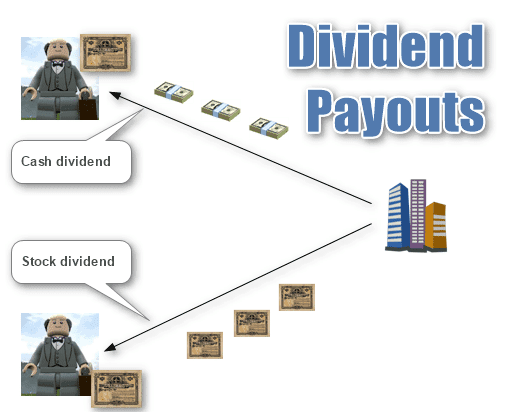
Some companies choose to pass on the earnings to their shareholders, while some companies prefer not to. Companies can pay dividends either in cash or issue shares of stock. There is no strict rule on the timing of the dividends or the payout rates.
A company can choose to pay out the corporate earnings are dividends. However, some companies prefer to use the earnings to reinvest all of it back into the company itself.
If you look closely you will notice that mostly mature companies offer to pay dividends. A mature company is one that is well established with a stable business. In such cases, companies use dividends to keep their investors happy.
Companies that prefer to use the corporate earnings to reinvest in their business are those that are in a growth phase. Therefore, new companies on the stock exchange do not offer dividends.
Due to the stability of the business, dividend paying companies are not high growth stocks. As a result, in most cases, the share price is relatively stable. Investors prefer to use these companies in order to earn stable income.
Some investors also make use of dividends to re-invest back into the company. This comes by buying additional stock in order to increase the amount of dividends earned.
Besides the above, there are also reasons of tax. Dividends usually attract a smaller amount of tax compared to capital gains.
Pension funds and other investment firms prefer to allocate a good part of their portfolio into dividend paying companies.
When a company pays dividends, investors view this as a measure of the company’s financial strength. This also gives a positive outlook for the business and its future growth. Paying dividends also makes the stock more attractive as new investors pour in.
What is a dividend per share?
The dividend per share, as the name suggests is the amount of dividend a company pays for every share an investor owns. In other words, the dividend per share is the sum of the declared dividends for every outstanding share there is.
Calculating dividends per share is very easy math and there aren’t that many variables involved.
However, you need to know about two important things; the total dividends which a company will pay and the shares outstanding for the company in question.
When you divide the total dividends by the number of outstanding shares, you get the dividend per share.
Dividend per share = Total Dividends Paid/Shares Outstanding
Another way to calculate the dividend per share is to multiply the earnings per share by the dividend payout ratio.
Dividend per share = Earnings per share x dividend payout ratio
The dividend per share is one of the important metrics. It allows the investor to determine the amount of cash they will get on the basis of the shares they hold.
Dividends are a type of income for the shareholder. Therefore, dividends per share are a single and straightforward metric to analyze how much cash flow you expect.
In an era when interest rates are low or near zero, dividends have become an important aspect for investors. This study compares how dividend investing performs against yields in bonds.
The dividend declaration and payment date
Dividends can also fluctuate from one period to another. There are a number of factors that can influence the amount of dividend a company can pay.
These factors range from industry developments and consistent performance of the company. The company’s CEO and management team are also responsible in a way.
A company’s board is the one that decides how much dividend to pay.
There is a declaration date. This is the date when the board declares its intentions to pay dividends to its shareholders.
This immediately creates a liability on the company’s accounting books. When a board declares the dividend, after approval a dividend payment date is set.
Following the procedures, dividends are then distributed to the shareholders.
The dividend declaration date is important as it tells you when you will get the dividends. You can get the information from many websites. This is an example of a dividends declaration calendar. The calendar shows the declaration date and other details.
You can also read an example of a press release when a company’s board declares the dividends. This is the most recent example of McDonald’s dividend increase.
As you can see, the company’s board first decides on the dividends before declaring and approving it. In the above example, the company in question, McDonalds’ board was approving an increase in the dividends its pays to its shareholders.
Example to calculate dividends per share
The example below should allow you to see how easy it is to calculate dividends per share.
A company announces total dividends of $100,000 for its shareholders. This means that you can take the number of total shares outstanding. For example, if we have total shares outstanding of 1 million, then the dividends per share is $0.10 (ten cents).
As an investor, it is important that you understand the concept of dividend per share metric. Dividends per share show investors how a company is using its income.
Investors can further dig deeper into a company’s financial statement to see how much of its income is paid as dividends.
For investors, dividends per share are perhaps the most straightforward way to calculate the dividend payments they can expect from a stock.
What are dividend yields?
Dividends can also be expressed as a percentage known as dividend yield.
Another term to describe this is the dividend to price ratio. The dividend yield comes by dividing the dividend per share by the price per share.
You can also calculate the dividend yield by taking the company’s annual dividend payments and dividing it by the market cap.
Dividend yield is a metric that can help in calculating the earning on the investment when you consider only the returns in the form of dividends. This is a good way to understand how much cash flow you get for each dollar you invest in the company.
One could also call this measuring how much bang you get for your buck. It is important to note that when there are no capital gains, dividend yields is basically the return on investment for the stock you own.
Let’s take an example of how you can calculate dividend yield.
A company declares annual dividends of $20 per share. Let’s assume that the company’s share price is at $100. Based on these two variables, you divide the annual dividends by the share price. Therefore, 20/100 gives you 0.2 or 20%.
The 20% is the dividend yield.
You can also calculate this backwards. For example if a dividend yield is 3% and the company’s share price is at $55, then the annual dividend is $16.5.
DRIP investing – What is it?
Since we are on the topic of dividends, it is worth knowing to learn about DRIP investing. DRIP stands for Dividend Re-investment plan. As the name suggests, DRIP allows you to reinvest the dividends that you earn.
Dividend reinvestment helps you to use the cash you earn as dividend to purchase more stock in the company. As a result, over time you start to increase your share in the company. When the number of shares grows higher, in turn you get higher dividends.
Many companies allow you to invest in a DRIP. Unlike trading at a stock exchange, DRIPs can only be redeemed directly with the company.
DRIP style of investing is also quite preferable because it is a low cost way to accumulate more shares in the company. The downside is of course that the investor needs to hold the stock for a long period of time.
A company can directly offer the dividend reinvestment plan as it is also cheaper. There are no commissions or brokerage fees making it a cheaper way to invest in a company.
Furthermore, DRIP investing is certainly not for those investors who prefer higher growth.
Dividend investing became quite popular at time when other fixed income assets gave lower yields. This whitepaper explores the three concepts of dividend investing strategies which is worth a read.
Dividends per share – In conclusion
As you can see, dividends per share metric, is not that complex at all. In fact it is one of the simplest of financial ratios that is easy to remember.
For many investors, investing in stocks is all about getting higher returns. But with dividends, you can also create an additional stream of income. In the current market conditions, dividend investing can most likely outperform the yields one can get from bonds.
It is important to note that dividends are not set in stone. Just as the example we saw before (McDonalds announcing an increase in dividends) a company can just as easily cut back on dividends.
Therefore, while dividends offer you a steady stream of income, remember that this comes from the company itself. During economic downturns, any company can be affected. In such cases, dividends are the first cash flows a company can target to cut back on spending.
As this article lays the basic groundwork on dividends and dividends per share, you can now start to explore more about dividend paying companies.
As with anything, investing is risky and dividend investing, as safe as it might sound is also risky.
Tags:
About the Author
Al Hill
Co-Founder & CEO, TradingSim
Alton Hill is the Co-Founder of TradingSim with over 18 years of trading experience. He completed the Design Thinking Bootcamp at Stanford’s D.School and brings expertise in Product Development to create the best trading simulation experience. His strategy focuses on trend-following systems, targeting high-volatility stocks with strong primary trends using the 15-minute chart.
The Power of Compound Returns – The Pay It Forward Challenge
Compound returns is one of the most powerful concepts in the world of investing. Albert Einstein states “Compound interest is the greatest wonder in the world. He who understands it earns it…he who...
Dividend is one of the most interesting aspects of investing and has its own following. Dividends are little extra add-ons that you get when you own shares in a company and are always welcome by...
What are Class A Stocks Class A shares is a term for both stocks and mutual funds. With stocks, Class A shareholders have the most rights of any shares issued by the company. So, why would an...